

Learning the “Right” Lessons from 2024
A political and media retrospective featuring Steven Bonnell II (Destiny) and PF Jung.

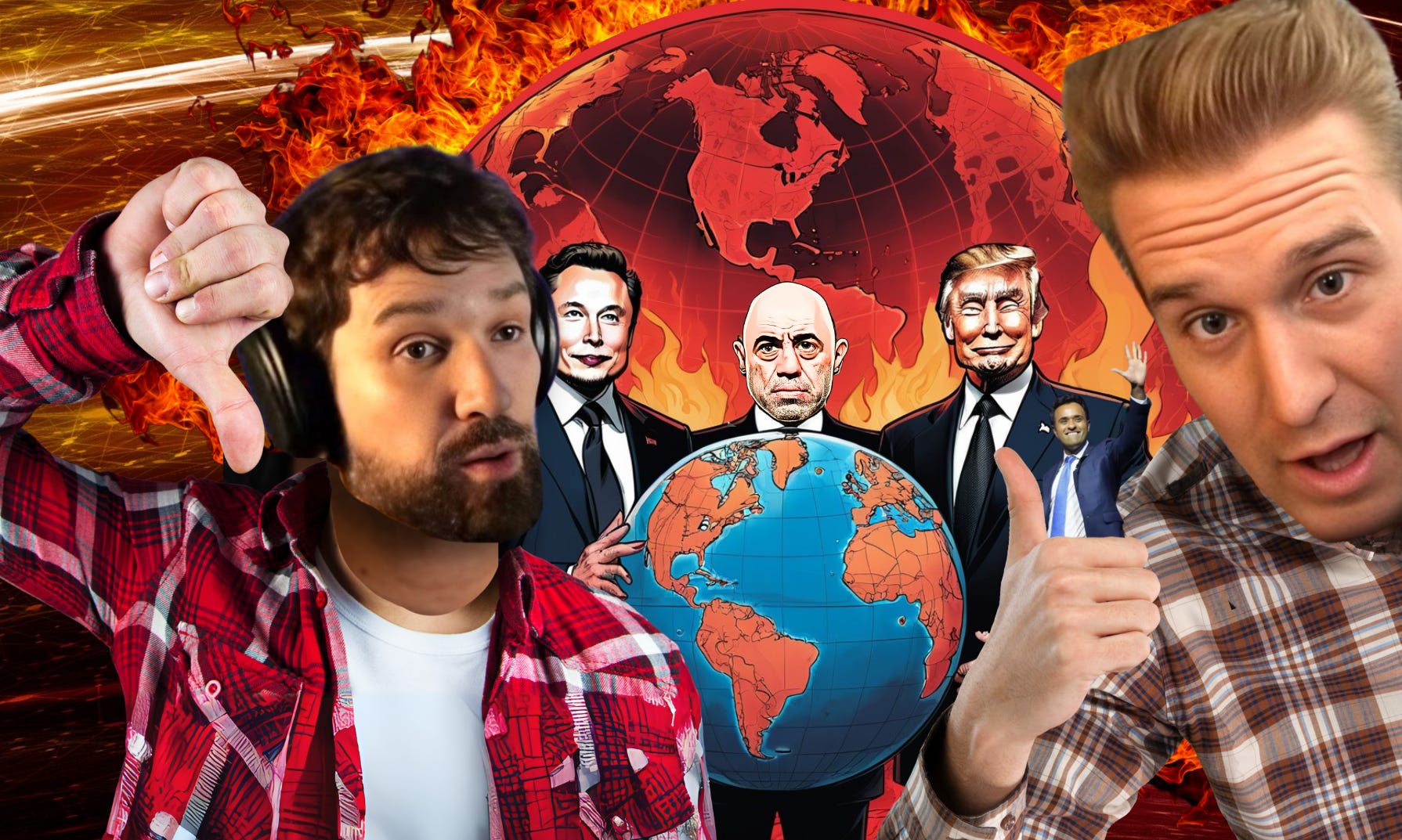
After suffering another defeat to Donald Trump, most Democrats began one of four processes:
Depression
Reflection
Denial
Joker Mode (“I hope every awful thing we warned Trump would do, happens… because fuck you for voting for him.”)
Since Trump’s win over Harris, one of my favorite political commentators, Destiny, has repeatedly recoiled at the idea that Democrats need to enter a stage of reflection; arguing that,
1. Republicans didn’t engage in a period of reflection after Trump’s defeat in 2020, therefore, Democrats shouldn’t do it now just because we lost.
2. Instead, we should focus on building a better liberal alternative-media ecosystem.
Before we discuss Destiny’s conversation with PF Jung, let’s unpack those two statements.
1. Republicans didn’t engage in a period of reflection after Trump’s defeat in 2020
As a factual matter, Destiny is just incorrect here. Republican’s lost to Biden in 2020, and the GOP thought about it and said, “We could listen to the Mitt Romney’s and Liz Cheney’s of our Party and chill, or we could quadruple down on Trumpism, elevate Trump to God-tier status, and do whatever he and his oracles command.” They chose the second option.
They could’ve went one way, but they went the other. And denying that fact, which Destiny never does otherwise - but does by logical implication here — lets everyone in the Old GOP off the hook for what the GOP has become.
And certainly, one could argue that the strategy of the New GOP has paid off big time politically. However, the long-term effects on the country itself and the Republican Party in the medium-to-long-term remain to be seen.
Then as a political matter, even when it’s factually correct to say, “It’s not fair. They don’t have to.” It’s the most limp-dick, sour grapes, childish response to a valid suggestion — especially when you don’t follow it up by saying something like,
“The kind of reflection your suggesting the Democratic Party go through was never demanded of the GOP in 2020 when they lost to Biden, so even though it’s another example of the insane double standards the media has towards Democrats, we’re better than them, so we’re going to study what went well, what went poorly, and figure out what kind of infrastructure we need to build to keep up with the Right in getting our message to voters.”
2. We should focus on building a better liberal alternative-media ecosystem.
If there is one thing “online” and “offline” Democrats and left-leaning political commentators seem to agree on, it is the need for Democrats to build a robust alternative-media ecosystem.
On this point, I couldn’t agree more with Destiny (and the rest of the group).
But who does it and how it looks matters.
A few people have suggested using Progressive Victory as the vehicle to do that. Unsurprisingly, those making that suggestion have a financial interest in making that very bad idea happen.
If you'd like to know why anyone not already thoroughly entangled with Progressive Victory should avoid them like the plague, feel free to read the article shown below.
https://polsint.substack.com/p/fec-complaint-re-progressive-victory
But keep in mind... while Progressive Victory is (in my opinion) unsalvagable at this point, having a liberal version of a group like Turning Point USA is almost a necessity moving forward.
A far better option would be a constellation of new media outlets, including new ones like Destiny's long discussed “Omni Media Group” and ones you may not have heard of like Civic Media here in Wisconsin - similar to the Right’s media ecosystem.
But, like turning to PV for this task, another bad idea is the repeated insistance that Democrats need to “find the Left’s Joe Rogan.”
First, you don’t “find” or annoint a Joe Rogan type character. Much like Trump, or even Obama on the left, they are anomolies that will appear and rise organically.
In the case of Rogan, he’s been doing his podcast since 2009 and only really began surging in popularity around 2015 - and it’s only been upwards from there.
On the traditional political side, consider all of the conservative politicians who have tried and failed at capturing the “Trump Magic” and the countless politicians on the Left who were definitely “the next Obama” and inevitably failed to live up to the hype.
But before we put the Rogan thing aside, the most important thing about Joe Rogan that most Democrats aren’t aware of - and is the real reason Rogan now has such a massive impact on American culture and politics - is the key concept of, what podcast bros call, “The Rogansphere.” And this is where I think someone like Destiny could be hugely impactful - particularly if he gets some independent feedback on the true strength of his personally favorite “orbiters" (which seem to change every six months or so).
If you are unfamiliar with the "Rogansphere" of Influence, I put together a brief (and super simplified) video explaining what it is and the types of people who it is comprised of. But if you are already familiar with the "Rogansphere" feel free to skip the video.But let's now focus on Destiny's conversation with PF Jung.
The problem with Destiny is that his greatest gift is often his greatest curse - he’s so good at argumentation he can “win” an argument even when he’s arguing for the “wrong” side.
This dichotomy was on full-display during his recent debate with Jung who likes to claim the mantle of “Enlightened Centerist” but really is - whether he cares to admit it or not - the perfect embodiment of this A+ meme:
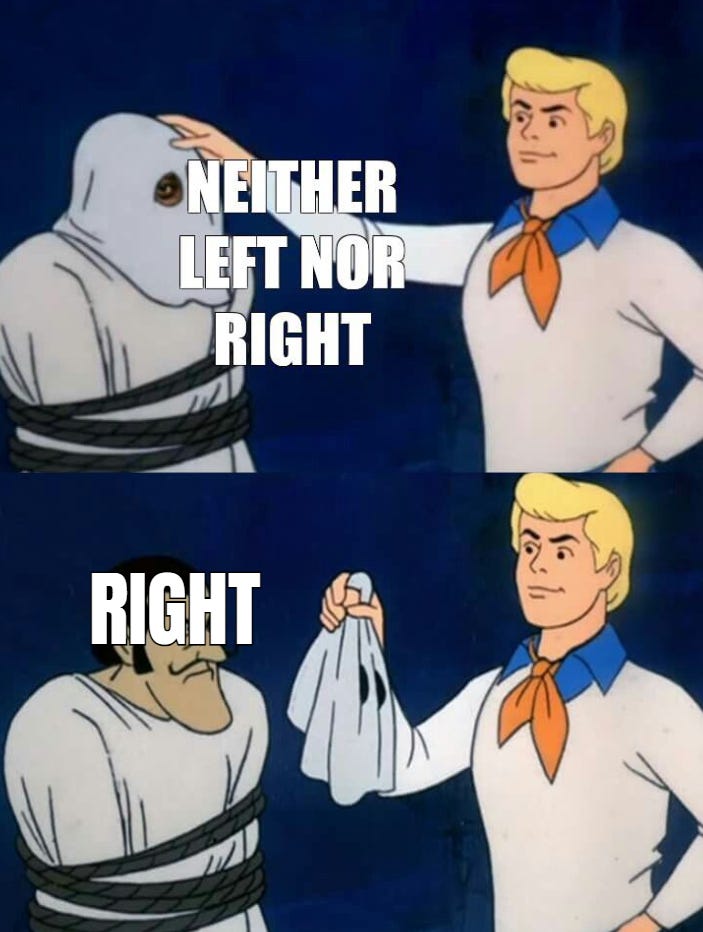
Their conversation was as intriguing as it was frustrating to watch, and covered a lot of ground but here’s a quick summary:
Jung and Destiny had a fairly broad discussion about the modern political landscape, with much of the conversation focused on one of Jung’s favorite politicians, Vivek Ramaswamy, his policies, and the influence of media narratives in shaping public perception of candidates like Trump, Harris and Biden.
The nearly three hour conversation was full of fits and starts, but ultimately - if you ask me - was a three hour exercise in two smart guys (smart in different ways) spinning their wheels and getting nowhere.
As a Democrat and fan of Destiny’s, it is always incredibly frustrating to watch someone so incredibly gifted at argumentation unable to win over a person like Jung on almost anything of significance no matter the tone or tactic he uses.
Debates like these then, largley become acts entertainment and political theater, but also point to a very real and significant problem Democrats need to resolve: even the best Democratic messengers can’t reach guys like Jung - and have been losing our ability to do so for some time now.
But it wasn’t always like this.
I cut my political teeth working for Barack Obama, and guys like Jung were as big of a part of that campaign as anyone.
In fact, it was two UW-La Crosse College Democrats, strikingly similar to Jung, who scraped up just enough money between themselves, their roomates (and drinking buddies) to open an Obama field office in early 2007 - well before the Obama campaign even considered investing in campaign infrastructure in Wisconsin - just down the street from the bustling Hillary Clinton for President office that seemed to be overflowing with cash and smug old-school 60-something feminists who loved routinley dropping by our office in the early days of the primary to mock our ramshackle office and our “hopeless” candidate.
And it was in that rinkydink old storefront that I, a highschool student at the time, found my life’s purpose, and where I would spend every spare second of my life - eventually choosing not to go straight to college so that I could instead become an Obama Organizing Fellow, and eventually a paid organizer running massive phonebank operations, constant canvassing efforts, and much more, including directing many of the same nasty Hillary Clinton grannies to do work for Obama (even while the worst of the bunch of would say things like “you’re going to lose to a woman” after John McCain nominated Sarah Palin as his Vice Presidential pick, which we quickly corrected her by saying, “I think you mean we, Vicki. And no, we’re going to win.
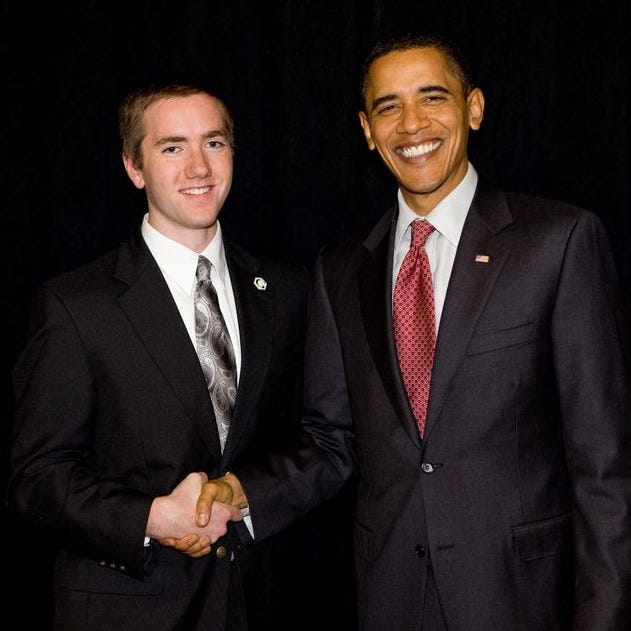
And win we did, and on the one year anniversary of President Obama’s historic election, I was invited by the White House to meet him in person on November 4, 2009 on a presidential trip to Madison, Wisconsin.
But back to guys like Jung.
And by “guys like Jung” I mean, unmarried 20-something white dudes who nowadays listen to Joe Rogan and liken themselves to be “independent-minded men just out here looking for the truth!”.
Jung, in his time speaking with Destiny, seemed nice, thoughtful, and sincere. Yet, at the same time… he didn’t seem serious.
By that I mean, despite Jung obviously taking himself and the conversation at hand very seriously, that doesn’t make him a serious political commentator.
And for what it’s worth, most online political commentators fit this exact mold, so my description of Jung shouldn’t be construed as a unique dig at him.
But let's assume I am wrong and Jung was and is a serious political figure.
If that is the case, that raises a very important and perplexing question:
If the left’s best online political communicator (Destiny) couldn't move Jung an inch over almost three hours, why is that?
Well, I have some ideas.
Destiny will be the first to tell you that he is such a good debater that not only will he always be able to argue his case exceptionally well, he can also always argue his opponent’s case better than they could.
But this also means that if Destiny gets a certain idea in his head, he can construct a bulletproof argument to support that idea where there is rarely any incentive or force strong enough to convince him otherwise. Which raises another very important question for Destiny (and his loyal following, of which I am certainly a part of):
What if the idea he has… is wrong? Or, perhaps, incomplete?
And what does it say when you have all the facts and figures on your side (as Destiny did) but you still can’t bring someone (like Jung) who disagrees with you to your side?
The answer, unfortunatley, might make Destiny’s head explode…

Much of the debate between Destiny and Jung came down to “vibes” vs “policy.”
And when I say “much of the debate,” I mean it… the words “vibe” and “vibes” were used no fewer than 25 times according to a transcript of their conversation.
Jung likes politicians based on vibes.
Destiny likes politicians based on policy.
Or, at least, that’s how they presented themselves.
As a result, most of their three hours were spent with Destiny explaining why the facts don’t support what Jung seems to think of politicians like Vivek Ramaswamy; and to be sure, Destiny did bring the facts, but even when Jung agreed with the case Destiny was making on a factual basis, Jung - in the end - disregarded everything he just conceded and reaffirmed his support for Vivek because… vibes.
Super frustrating, right?
So what’s really going on here?
The answer is fundamental to Democrats’ electoral future.
The Vote Chain
Vibe Check > Vibe Alignment > Value & Priority Matching > Campaign > Win/LoseAs I thought back to my own past campaigns for public office, the answer to Democratic struggles to break through to people like Jung — and Destiny’s frustrated attempts to win over Jung with facts and policies — became clear.
It starts with vibes and ends with a vote.
Policies, facts, and everything else, happens in between - and that's where Destiny spends almost all of his time these days.
To illustrate the case I’m making, let’s look at the last time I ran for public office, back in 2015.
My opponent was a longtime, well-liked, incumbent City Councilman and a retired Fire Department Division Chief, and almost three times my age.
He had all the right vibes for his district, he lived in the same neighbrhood his whole life, and had the kind of experiences that appealed to voters in that district, which was why he had been re-elected so many times.
But in my view, despite the fact that he and I generally agreed on the issues facing the city and how to fix them, he was just too slow and old and unwilling to rock the boat when the time called for that - and, in my view, having a Councilman like that was harmful to the city and therefore unacceptable to me.
So even though I knew it would be an uphill battle, I firmly believed I would be better at the job, and I had a plan to win… and it all started before even officially entering the race; and it all started with… vibes.
Let me walk you through the whole campaign, from start to finish, so you can see exactly what I mean. Don’t worry, it won’t take that long!
Here are the basic phases of a winning campaign:
0. Pre-Game.
How many votes will I need to win? And can I get them?
First. Vibe Check.
Get to know the district and its voters (the ones that count) before getting in the race.
Second. Vibe Alignment.
Align your vibes with theirs.
Third. Value and Priority Matching.
Create a campaign plan built on values shared with targeted voters and that puts the priorities of the targeted voters front and center.
Fourth. Campaign!
Vibe-Based Marketing supported by the right policies and facts… Maintain the right vibes with the right voters, (Knock doors, make calls, send mail)
Fifth. Win or Lose.
Vibe Check, then Vibe Alignment, then Value and Priority Matching, then Campaign, then Win or Lose.
5. Win/Lose
Vibe Check > Vibe Alignment > Value & Priority Matching > Campaign > Win/LoseReal Life Example: Londre for City Council 2015
0. Pre-Game.
(How many votes will I need to win and can I get them?)
After a trip to the City Clerk’s office, I was able to determine there were roughly 1,000 registered voters in the 12th District, and that between 500 and 550 votes would be cast in my race, putting my “win-number” at around 300.
I knew it would be tough considering the incumbent I was challenging, but I saw a path to victory and went for it.
First. Vibe Check.
(Get to know the district and the voters that matter)
You might think that if there were 1,000 registered voters in my district, I would target all of them. But that’s a sure fire way to lose an election.
Instead, I did what every winning campaign does - I targeted the right voters.
In my case, after I had acquired a complete list of every registered voter in my district, I knew exactly who voted in races like mine and which voters ones never did.
The ones who voted in races like mine were the voters that mattered. Everyone else was ignored.
And once I found out who the typical voter in my district was, I moved to align my vibes with theirs so that when they met me for the first time and saw my name… the vibes were right.
Second. Vibe Alignment.
(Align your vibes with theirs)
Take a look at the doorcard I gave to my targeted voters, and consider the vibes it would give a 50–75 year old working-class Reagan Democrat. And notice as well how light it is on specific policies.
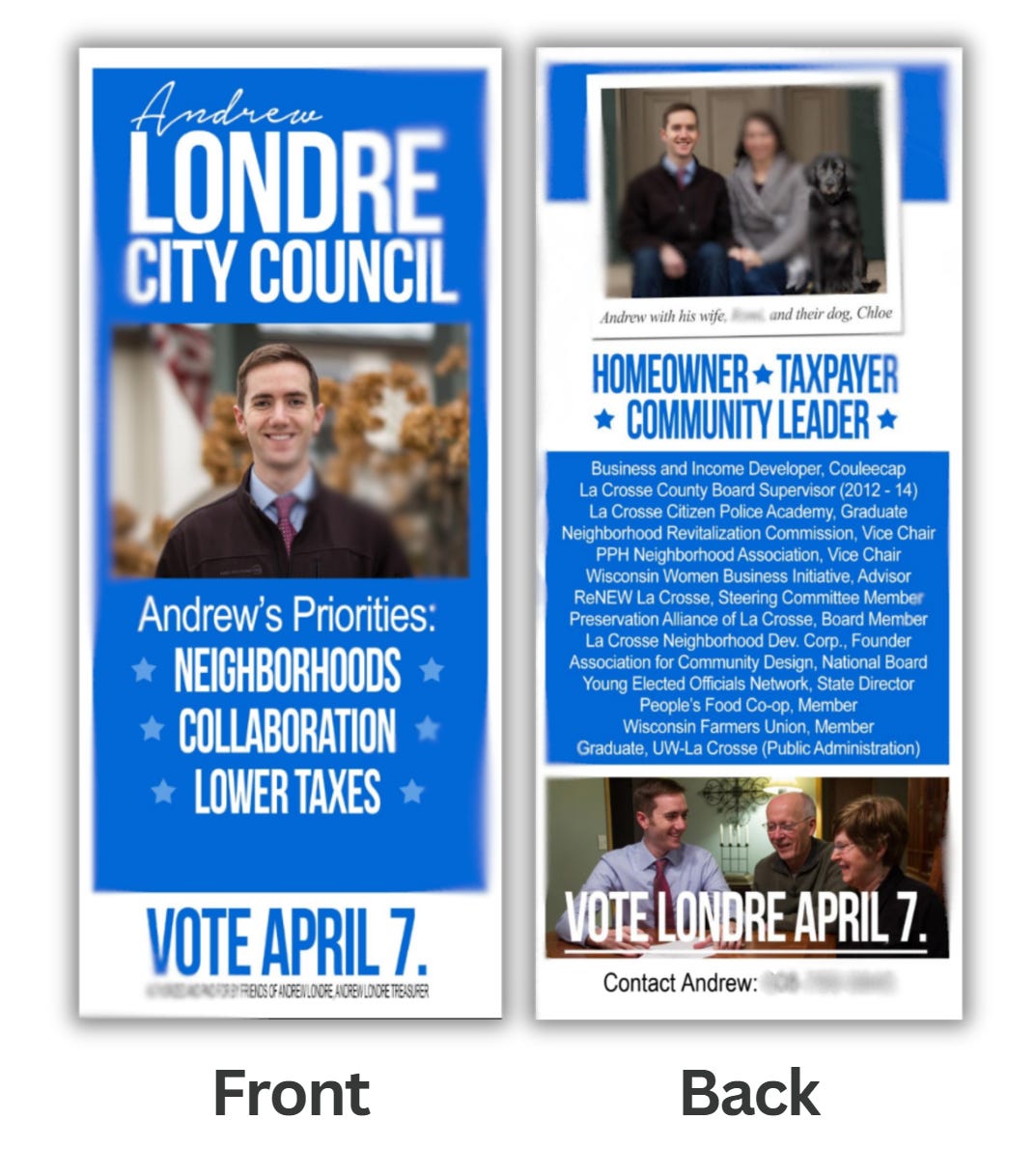
I was never going to be able to directly match the vibes of my voters like my opponent was able to - for many reasons, but most notably because of my age. So what did I do?
Well, remember, it’s not “Vibe Matching” it’s “Vibe Alignment”
I knew the voters I was after were the same people who had elected a 24-year old mayor a few years prior because they saw him as a wholesome, hard-working, breadth of fresh air. So that was my angle - and just like that, despite being unable to match the vibes of my electorate 1-to-1 like my opponent, I was able to align my vibes in a different way and give my opponent a run for his money.
Third. Value and Priority Matching.
(Create a campaign plan built on values shared with targeted voters and that puts the priorities of the targeted voters front and center.)
With my vibes aligned with the vibes my electorate was after, the next part was just as critical and just as straight forward.
If you’re targeting the right voters and know them as well as you should, you’ll know what they value and what their priorites are.
And once you know that, you make the values you share front and center, and you make sure their priorities are yours.
Fourth. Campaign!
(Vibe-Based Marketing supported by the right policies and facts… Maintain the right vibes with the right voters, (Knock doors, make calls, send mail)
Once you’ve got your vibes aligned, your values and priorities clearly defined, you execute your campaign plan.
In my case, I spent almost a year knocking on the same 300 doors — 3 hours a day on weekdays, and 6 hours a day on weekends — until I knew I had spoken to almost every one of the 600 names on my list. Then I started flooding their mailboxes with carefully crafted mailers, and as the mailing deluge began, I made it my goal to talk to every one of my targeted voters at their doorstep at least one more time before Election Day — and if I couldn’t reach them, I’d find their phone number and call them.
Fifth. Win or Lose.
So how did things turn out in my last race for public office?
Well, remember how I said that,
"By using historic vote data, I was able to calculate that there were roughly 1,000 registered voters in the 12th District, and that between 500 and 550 votes would be cast in my race, putting my “win-number” at around 300."
I was spot on.
I predicted that between 500 and 550 votes would be cast, and after all the votes were counted, 524 votes were cast.
I predicted the winner in the race would get around 300 votes - and indeed, the winner got 324 votes. Unfortunately, the winner in this case, wasn't me.
Nevertheless, despite losing the race, I am glad I ran and am proud of the campaign I ran.
Plus, to this day, I still hang on with pride to the fact that, despite losing the race, the district was made up of two wards.
My opponent got more votes in one ward. And I got more votes than him in the other.
Unfortunately for me, the ward he won (the same ward he had lived in his entire life) was much bigger than the ward I won, which ultimately made him the winner.
So you lost. Why should I listen to you then?
It’s true I lost my 2015 race for City Council, but I also I won a County level race a few years before that using the same formula I did in my City Council race.
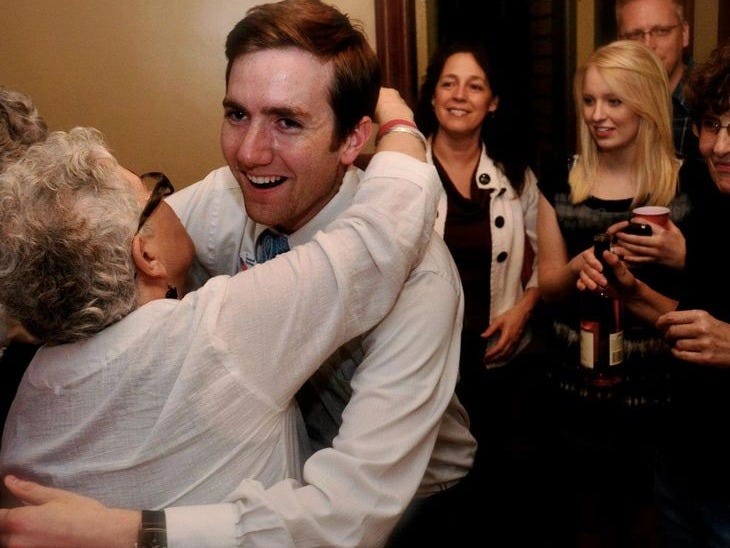
And sometimes, there’s more to learn from a loss than a win, including that there will be times that even when you do everything right and even when the voters like you (and say things like, “If you were running against anyone else I’d vote for you in a heartbeat, but I’ve known Fran since we were kids so I have to vote for him”) there are going to be times you still come up short.
So even though there is no true “Secret Formula to Winning Every Election Ever” the fundamentals of a winning campaign are always the same, and Democrats failed every fundamental element in 2024.
Bringing it back to Destiny vs. Jung and Harris vs. Trump
First. Vibe Check.
For several years now, the vibes given off by “the left” have drifted further and further away from anything that might resonate with several of the most reliable voting blocs, including:
Working Class / Union Workers
Latinos
Young Men
Second. Vibe Alignment.
For years (going on decades) Democrats have taken many voting blocs - including the three aformenttioned demographics - that once were the bedrock of the party for granted; increasingly, Democrats are also taking for granted racial minorities - in particular Black Americans.
And as polls show the Democratic Party bleeding support from these - and other - groups, Democrats have opted instead to play a dangerous game of pandering to increasingly niche, unreliable, and politically toxic groups that have no problem stabbing the Democratic Party in the back 9 days out of 10 and then at the last minute, Democrats return their attention to the voters we used rely on and expecting to get their votes by default.
Third. Value and Priority Matching.
If a winning campaign plan is built on values shared with targeted voters and that puts the priorities of the targeted voters front and center of the campaign, in what universe would an honest person say that the Clinton Campaign or the Harris Campaign (the two campaigns that lost to Trump) did that (if the bread and butter demographics of their campaign strategy were guys like this?):
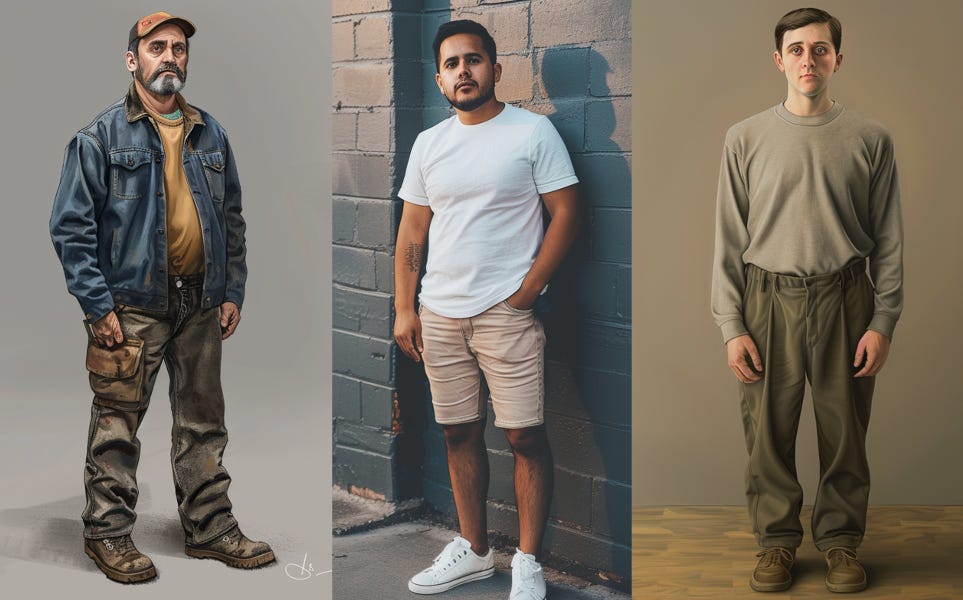
Fourth. Campaign!
Many professional and wannabe pundits have said that Harris’s team ran a terrible campaign, but I disagree; Harris’s team perfectly executed their campaign plan… the problem was that the plan itself was fundamentally flawed - they took key demographics for granted, dramatically over did it trying to win over moderate Republicans, and didn’t communicate with the voters that Trump spoke with or even attenpted to connect with these voters where they prefer to communicate.
Harris’s campaign ran a vibe-Based Marketing Campaign, but the vibes were all wrong with the voters she needed to win, even though her policies were dramatically better for those key groups that swung to Trump.
Fifth. Win or Lose.
Ultimately, Harris loss for a few key reasons:
Her campaig targeted the wrong voters
She failed the vibe check with the voters she needed to win
She and her surrogates failed to communicate with the voters she needed to win
Important Side Note:
Speaking from personal experience (as a candidate, campaign manager, community organizer) and political scientist, I can also tell you that the most fundamental aspect of political communication is understanding that the one thing every losing campaign does is they talk TO voters and AT voters.
Conversley, every winning campaign talks WITH voters while LISTENING TO voters.
Of the three candidates who have taken on Donald Trump, only Joe Biden has won, and a major part of his success was that he made voters feel like he was listening to them and shared and understood their concerns, and when he engaged with voters… he was talking with them, not AT them.
No one likes to be talked AT.
Unfortunately, both Hillary Clinton and Kamala Harris made certain demographics feel they weren’t being listened to, and if there ever was any communication from the campaign it always felt like the candidate and campaign was talking AT them.
Beyond Vibes - Voters will always favor the candidate they see themselves in.
If we take a look at which demographic groups delivered the 2024 Election to Donald Trump, just ask yourself if the average member of that demographic group sees themselves more in Trump or in Harris?
1. Voters with No College Degree
Donald Trump’s ability to entice non-college educated voters from the Democrats has been core to his new Republican base. After being +4 on Biden in 2020, he was +12 on Harris in 2024.
2. Latino Men
A slim majority of 51% of Latino men voted for Harris, compared to 46% for Trump and 56% overall. 63% of Latino voters supported Biden four years ago.
3. Young Voters
The youth vote, often seen as a vote staple for left-leaning parties across the western world, was its worst for the Democrats in this election, with data showing Kamala Harris leading Trump 52–46 within this demographic.
That six-point advantage compares to Biden’s 25-point buffer over Trump in 2020, and Hillary Clinton’s 18-point lead in 2016.
The Democrat advantage was also the smallest in the three Trump elections among the 30–44 voter group — just four points compared to the 12-point held by Biden.
Now take a look at Trump’s appearances on podcasts like Andrew Shultz’s Flagrant, and The Nelk Boys’ Full Send Podcast.
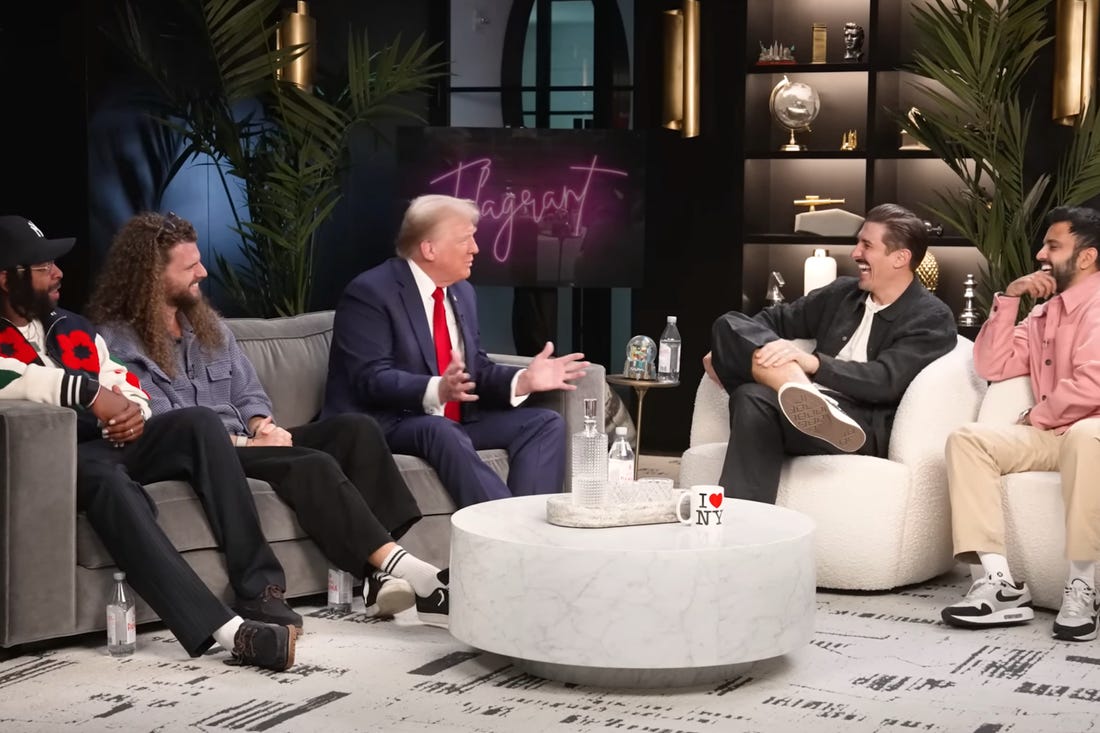
Trump didn’t go on podcasts like these, or appear with streamers like XQC and Adin Ross to talk policy. If he wanted to talk policy, he would have sat down with mainstream news outlets — which is exactly why he blew them off.
Trump’s podcast approach was very purposeful, and frankly brilliant. These appearances were designed to reaffirm two things with young men, Latino men, and regular dudes without college degrees:
1. “Trump is one of the boys.” (Reaffirming good vibes and allowing the viewer to see parts of themselves in Trump, both as they are and as they wish to be.)
2. “Kamala ain’t like us. She can’t hang with the boys.” (Reaffirming the vibes among these specific demographics that not only doesn’t Kamala “get” them, she doesn’t even like them — afterall, where is she appearing? Call Her Daddy and mainstream media.”
The result? A huge number of young men, working class guys without a college degree, and Latino men, felt that there was nothing in Harris that they could see in themselves. So, they went with Trump.
I hate to be the bearer of bad news, but... Politics Isn’t About Policy
The first time I ran for office at the age of 18, (a race I would go on to lose by just three votes) I quickly learned two tough but valuable lessons:
1. It is exceedingly rare for a voter to vote based on policies. It’s almost always based on vibes.
2. I also learned after knocking on just two doors as a bright-eyed candidate for local office - under the watchful eye of one of my mentors who was waiting in his car to take me to my next targeted voter - that the last thing a smart candidate (the one’s that know how to win) will do is talk to voters about policies — instead, you spend 20 seconds (maximum) at the doorstep of every targeted voter to say,
"Hello! My name is Andrew and I’m running for City Council. I just wanted to stop by to introduce myself and give you some information about me and why I’m running."
“Oh. Thanks. Nice to meet you.”
"Absolutely! I’m doing my best to meet every voter before election day, and I don’t want to take up too much of your time, but if you have any questions at all, my phone number is on the bottom of this card and you can always reach out if you have any questions."
“Thank you, I’ll take a look at this. I really appreciate you stopping by. Good luck! It was nice to meet you.”
*** I would then follow up that visit with a hand-signed and hand-addressed postcard thanking them for talking with me.
Still not convinced? Ask any experienced sales person, and they will tell you the last thing you want to do is get the customer to say the word “NO” or create any disagreement between the two of you, or even create the opportunity for the customer to disagree or say "no."
Policy-talk is fraught with opportunities for disagreement.
Here's another example...
If I knock on someones door and see an NRA sticker on their window, I’m probably not going to win them over on policy, but I can win them over by talking about our shared love of the Packers and how painfully slow the City Council is to do anything productive.
If you’re new to politics, or only exposed to politics through YouTube, Twitch, and Twitter, your head is probably exploding right now.
But sometimes the truth hurts.
And the truth is, this is how you win elections: Vibes. Vibes. Vibes.
Policy happens when you win.
Democrats need to remember (and in many cases learn) how to win, first.
And by the way… what I’m describing is not new.
It’s been this way for as long as I’ve been in politics, and that’s approaching 20 years at this point (long before Trump).
And it’s not unique to the left or the right.
The way it really works is like this:
~ 70% of people vote D or R every year.
~ 30% are “persuadable”
~ 70% of “persuadables” will vote on vibes
~ 30% of “persuadables” will vote on a single policy
~ 0% of voters sit down and plot out their Top 10 Issues and then independently, studiously pour over every detail of the competing candidate’s platforms, rank how each does, and then analyzes the implementation of each policy, only then to determine who they’re going to vote for.
Destiny is brilliant in many ways and I have come to respect him for many reasons, however, until he let’s go of the idea that voters vote on policy and details, he’s going to continue to fight a losing battle and engage in frustrating conversations with guys like PF Jung.
Remember, the process to earn someone’s vote is a linear chain of events, and you can’t skip ahead to conversations about policy if you skipped all the vibes-related steps before.
Ironically, though, in the sick game of politics, if your opponent skips or fails the vibes-phases of the game and you nailed it, you can skip the rest and just cruise to victory on vibes alone, which is exactly what Trump did in the last election.
But what about those commercials about trans policies?
If you lived in a swing state like I did in 2024 you would have seen a commercial claiming that Kamala Harris wants to use the US prison system to transify every single inmate.
Destiny brings up this commercial and conversations about trans-athletes often, and every time he says something that is factually true, but misses the forest for the trees.
“These people act like this is all Democrats ever talk about or care about. Most Democrats don’t even support it. We don’t talk about it. Republicans are the ones always bringing it up!”
He’s right. But politically, that’s not what matters.
What matters is that there are a lot of niche issues that have an obvious right and wrong answer to the average voter, but when a Democrat is asked on national TV an easy question about trans people and their response is waffled, meandering, and ultimately leaves the door open for interpretation, they have gifted their opponent political dynamite.
By trying not to hurt the feelings of a group that makes up .000001% of the population, they provide an answer in the form of a non-answer, and if I’m Candidate A, and Candidate B isn’t willing to tell you how they really feel… you better believe I’m definitely going to tell you how they “really” feel.
And then a vicious cycle begins:
I say,
“My opponent danced around that question because what they really believe is this. Which is crazy. And people who believe that, also usually believe this other crazy thing. I’m not saying they do for sure, but you should probably ask them.”
Then a day or two later my opponent is asked,
“Do you want to clarify what you meant with that first waffling answer? And could you also tell us how you feel about this other thing?”
Until my opponent gives a clear answer, the cycle continues. And the longer the cycle continues, the more the public believes that,
“Yeah, they probably do believe these whacky things. Why else wouldn’t they just say No?”
And by that point, my opponent is super fucked. Because they’ve made their vibes irreversably tainted.
Now the public thinks they are obsessed with super weird stuff, and they’re not a straight shooter — and who’s going to vote for someone you think is probably into some fringe weird stuff, especially if you think they’re trying to hide it?
Even worse, they can’t throw that .000001% minority group under the bus now — it’s too late. If they do, the regular folks won’t believe it and will see it purely as a desperate attempt to save face, and the obscure minority group will see it as a cataclysmic betrayal.
This is what happened to Harris.
To be clear, Democrats should absolutely remain the socially liberal party that will stand up for minority groups when we’re in office, but the public needs to understand that our primary concern are regular folks with regular issues we can solve.
Unfortunatley, because far too many Democrats are afraid to say things like, “No, trans-women shouldn’t compete against biological women in sports. Next question…” regular folks with regular issues are beginning to believe that every niche minority group is a greater concern to us than the normie voting population.
The same is true at the local level. The principle remains the same, but the scales are the only real difference.
For example, every time I ran for office, I was heavily supported by unions, but the people who voted for me were often quite anti-union. So, guess what? I didn’t talk about unions with voters. I didn’t mention my union endorsements on my materials.
And the unions didn’t have the slightest issue with that - in fact, they supported it. They knew that I’d be there for them when I won, and if I talked about how much I love unions while I was campaigning, I’d probably lose and an anti-union candidate would win.
The truth is, there are a lot of people within the Democratic coalition who simply need to grow up and realize that Democrats will be there for them when they win (whereas Republicans will do everything they can to crush them) but in order to win, Democrats are going to have to ignore them most of the time, keep their distance other times, and they just need to shut the fuck up. Harsh words, but the reality of the Republican alternative is infinitely more harsh.
Closer: “Democrats Don’t Care About Working Class People”
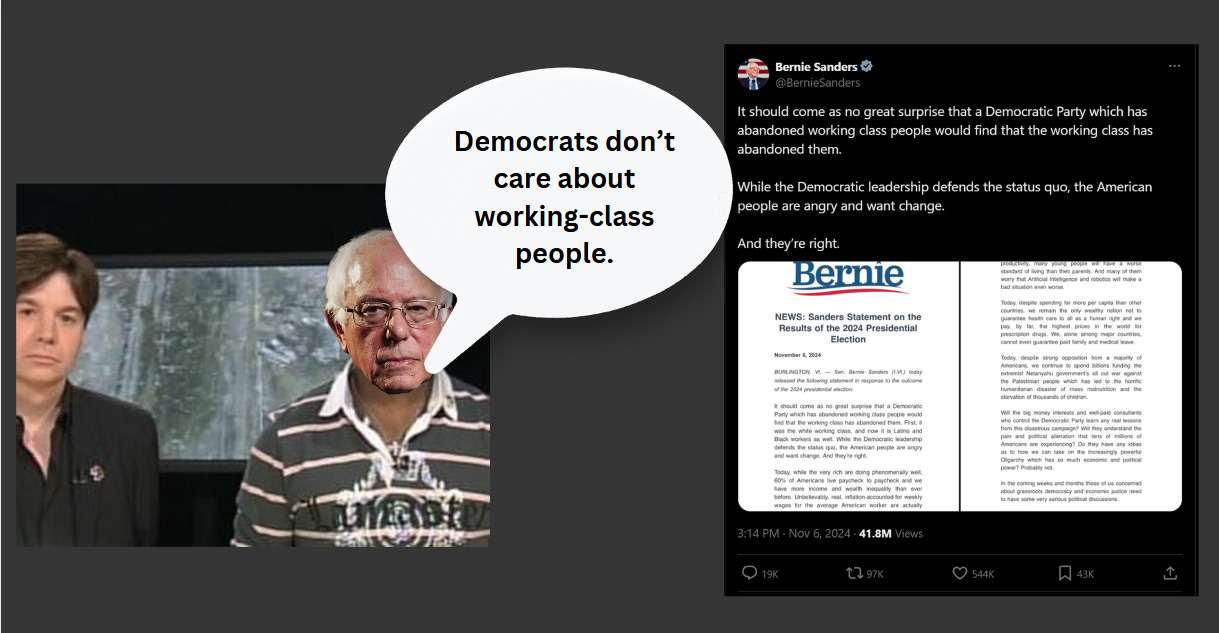
The day after Harris’s defeat, Bernie Sanders issued a very Bernie Sanders kind of statement, bluntly claiming that, “[The] Democratic Party has abandoned working class people” and as a result, “working class people have abandoned them.”
This statement is almost completely false. And thousands of angry Democrats let him know it. Here’s a great example.
And Mr. Sears is not wrong.
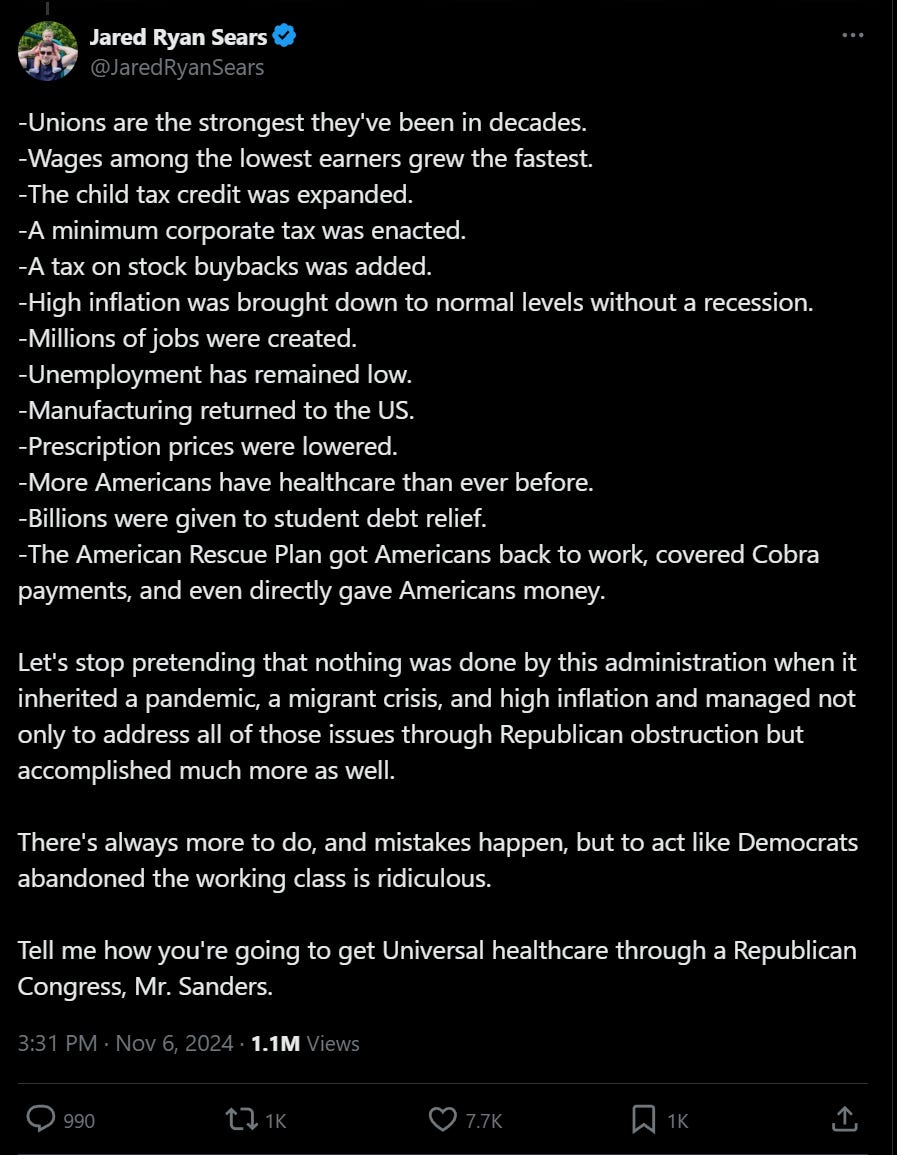
Democrats, in recent history in particular, have delivered for the working-class over and over and over… and yet… there is still something truthful about what Senator Sanders said about the Democratic Party abandoning the working class. Vibes.
Working class people increasingly don't feel like Democrats are in it for them.
That's the vibe we give them.
And that's why they give us big L's far too often.
People don't vote based on policy.
They say they do, but they’re lying. (And we know how routinely voters will say one thing and do the opposite.)
Policies are the final piece of the puzzle.
Policies are the proof.
And yes, the policies, are - truthfully - what really matter at the end of the day.
But Senator Sanders seemed to be getting at the other truth, which is that despite the historic pro-labor, pro-working-class policies, passed by Democrats, the benefitiaries of these policies are indeed abandoning the Democratic Party because they feel increasingly disconnected from the Democratic Party.
So how do we fix that?
Vibes. And vibes come from feelings and messaging.
The Democratic Party needs to be led by people who have backgrounds that voters we need to win over can relate to, and who come from the kinds of places we need to win (swing states, not coastal major metros) and who have a track record of successfully winning swing voters without compromising the core values of the Party.
The broader left needs to build a media ecosystem in the same manner. When all of “liberal” media comes from New York City, Los Angeles, and - sorry, Destiny - places like Miami, the vibes from that media environment will always be disconnected from the vibes we need to establish with the voters we need to win.
Furthermore, we need to add more voices to the mix, particularly ones that are more relatable to the voters we need to win back; currently, virtually every “alternative” left media figure doesn’t have a working class background, doesn’t have a family, doesn’t own a home, and rarely - if ever - interacts with regular people.
This doesn’t mean we have to completely start over as a Party or throw out every left-wing political commentator we’ve got.
Instead, it means we have to make some adjustments.
Dial back some things, and ramp up others.
But we have to do it all according to the fundamentals of how to actually win elections, because if we don’t, we’re going to keep losing. It’s just that simple.
The good news is adjustments are easier than a complete restructure. And best of all, we already have the right policies to win. We just need to make the changes necessary to get all of the pieces we need and in the right order to win…
Vibe Check > Vibe Alignment > Value & Priority Matching > Campaign > Win/LoseWe can do this.
The question is, do we really want to?
I know I do.
How about you?
Excellent post. I think one way to conceptualize the role of people like Destiny is like actors on strings no one can see or really *control*. Destiny's is to be the attack dog, while others like David Pakman, Brian Tyler Cohen, or Jessiah from Pondering Politics are the sophisticated and more "gentlemanly" advocates. You can get this vibe strictly based on how all these people dressed before Destiny began to take some sensible fashion advice. You need attack dogs and gentlemen to maximize your chances of successfully converting others. Where Pakman's calm aura may encourage some to listen, others will be sucked in by Destiny's higher-than-average roast game.
One thing I would note about the Destiny vs Jung conversation is that Jung *dropped* the "vibes" requirement when it came to one particular topic - the trans issue. When that came up, he was entirely down to discuss evidence, RCTs, etc. You can often get a hint of what has broken a person's brain by what they act the most scientific about. I'm sure that if they debated that issue, then he'd still have some vibe/unstated assumption or axiom that justified not changing his view, but it's important to recognize this part of how people work.
I wish Destiny had the guts to be even harder than he was and directly call Jung out. I think Jung would have broken one way or the other, but better that than implying that there's nearly as much legitimacy to his viewpoint as he implies. It's especially galling for Jung that he's an internet commentator who *has* the time to dig into the evidence, but insists on the importance of vibes for determining his own views.
There's a book you might be interested in reading called "Where have all the Democrats gone?" It came out in 2023 and more or less called out the party for the exact issue of being economically disconnected from the working class and being significantly more culturally liberal than the average voter. It also highlights the history of how that shift occurred. One lesson in it is that there's actually far more independence of left-wing media, thinktanks, etc. from the Democratic Party than there is on the conservative/Republican side.
Thank you for this article, it reflects some issues I have had with Destiny since the election. Just yesterday he started the stream with how the US needs so much more immigration to boost the economy, and I was left wondering if he just wants to concede all elections to the GOP until the end of time.
>Then as a political matter, even when it’s factually correct to say, “It’s not fair. They don’t have to.” It’s the most limp-dick, sour grapes, childish response to a valid suggestion
This was what I was thinking, and I could smell the ban if I even thought about writing it anywhere. But I think it's even easier - in a conflict of civilization versus barbarism, it's simply a given that the barbarians aren't using the tools of civilization. That doesn't absolve someone on the side of civilization from doing so.
>And denying that fact, which Destiny never does otherwise - but does by logical implication here — lets everyone in the Old GOP off the hook for what the GOP has become.
Letting the people that caused today's problems off the hook seems like a Democrat specialty. Neocons are now exonerated among Destiny's community, when they were the ones causing untold, lasting damage to the institutions with their lies about the Iraq war and all their other crimes. Obama, too, should receive a fair share of criticism, since many of today's problems including Russian interference grew big on his watch.
>First, you don’t “find” or annoint a Joe Rogan type character. Much like Trump, or even Obama on the left, they are anomolies that will appear and rise organically.
Bizarrely, he seems to think that you can create a media environment from the top down, such as with his idea of cutting out leftists who don't support the candidate. I'm not opposed to the idea itself, but I don't it would matter at all.
>It is exceedingly rare for a voter to vote based on policies. It’s almost always based on vibes.
It drives me crazy that Destiny and his general audience understand and don't understand at the same time that people run on vibes in general. Destiny loves economic growth, but economic growth is driven by consumer behavior, which, beyond the bare necessities, is based on vibes. He proclaims that people who "live paycheck to paycheck" waste their money on Uber Eats, expensive cars and Black Friday, but without these frivolous expenses, the economy wouldn't grow as much. But economic growth is his first and foremost priority, time and time again. You have to take the good with the bad. Fundamentally, irresponsible financial decisions are indistinguishable from irresponsible voting decisions.
This is fully in line with concepts like "revealed preferences" which he loves to pontificate about, but he fails to apply them to anything that isn't an economic textbook example. It's frustrating because he's a smart guy!